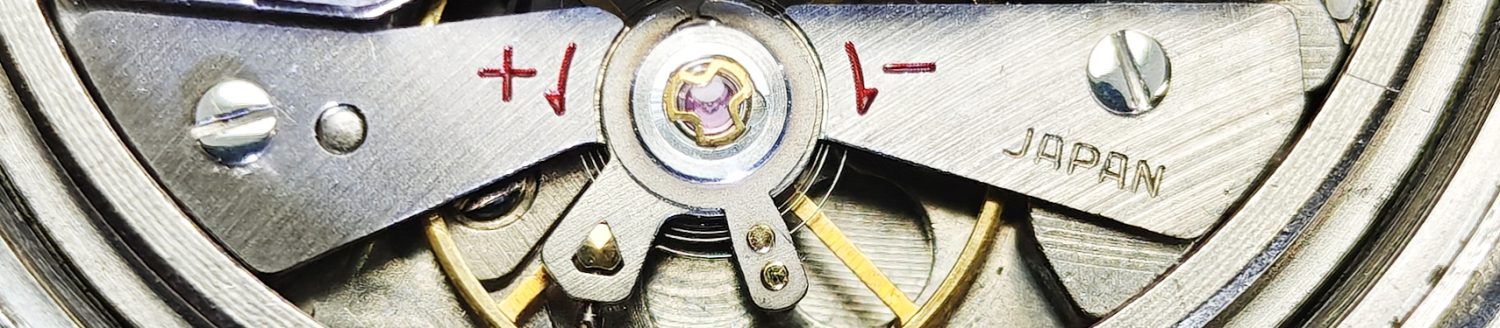
A modern innovation in material sciences has infiltrated the decades old realm of watch repair and restoration, providing amateurs such as myself with access to a small selection of the seemingly endless variety of tools and paraphernalia required for pursuing this hobby.
I am talking, of course, about the prolific expansion of the consumer-grade 3D printers’ market. Although the technology was developed in the 1980s, the patents for FDM (Fused Deposition Modelling) machines – the ones with a spool of plastic filament at one end and a hot extruder at the other that we are familiar with – came into the public domain in 2009 and it took another few years for the printers to be available in the affordable mass market.
A caveat here is that nearly all of the tooling and equipment related to watchmaking as well as repairs and restoration have to meet exact and perfect standards because of the minuscule scale at which most of the parts function. For example, the pivots of the balance wheels measure around 0.1mm in size – as thick as just 2 sheets of regular printer paper.
3D printing technology has a long way to travel before it achieves such a high level of accuracy and consistency in cheap consumer models but nevertheless, with the wide variety of filaments now available, there is a lot that can be printed in even the cheapest of printers just to make life a tiny bit easier – and deliver a sense of satisfaction in having a truly customised piece of equipment for yourself!
This is a continuously evolving field and tinkerers regularly come up with brilliantly thought-out designs and products. In this post I will share some of what I personally found very useful and may just be what you are looking for. A lot of 3D printed objects are ready to use hot off the printer but some may require additional hardware such as nuts and bolts or a bit of filing and cleanup for visual appeal.
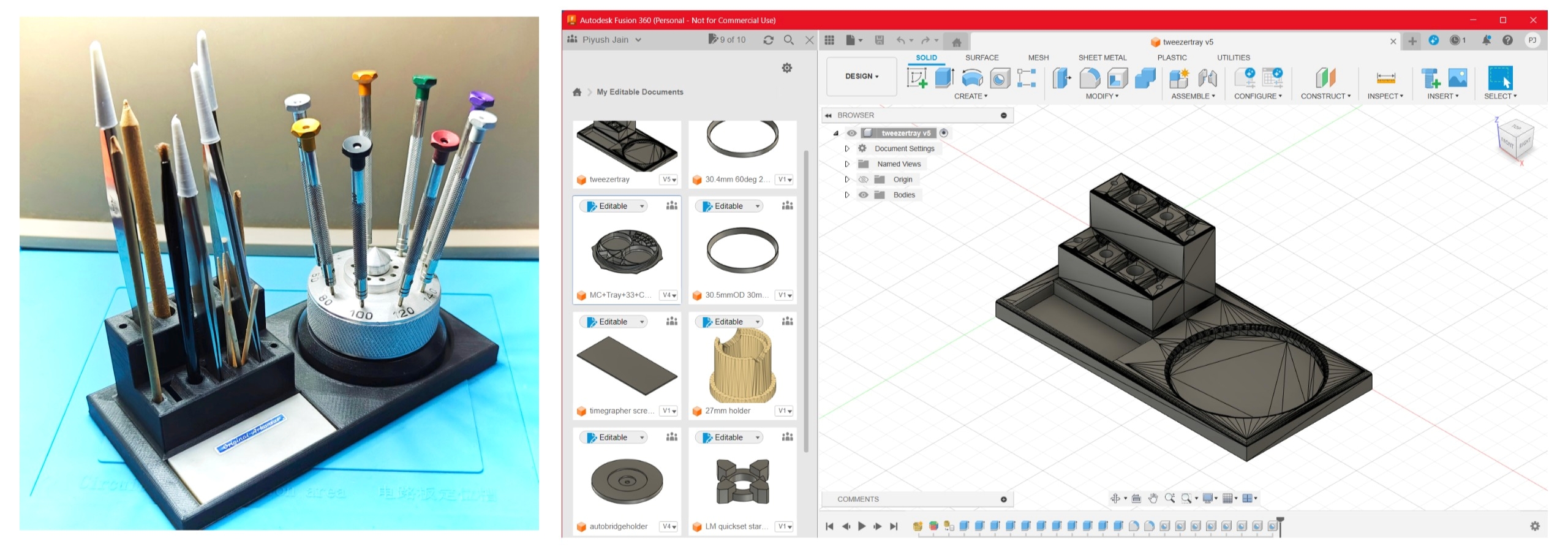
This is a multi-tool stand which holds the rotating screwdriver holder, an Arkansas stone, a few tweezers, brushes, pegwood sticks of varying thickness or something else you could fit in the slots. I actually customised it from a pre-existing design to suit me.
Its available as part of my designs and collection on a popular website where similar files are hosted: https://www.thingiverse.com/thing:6667638
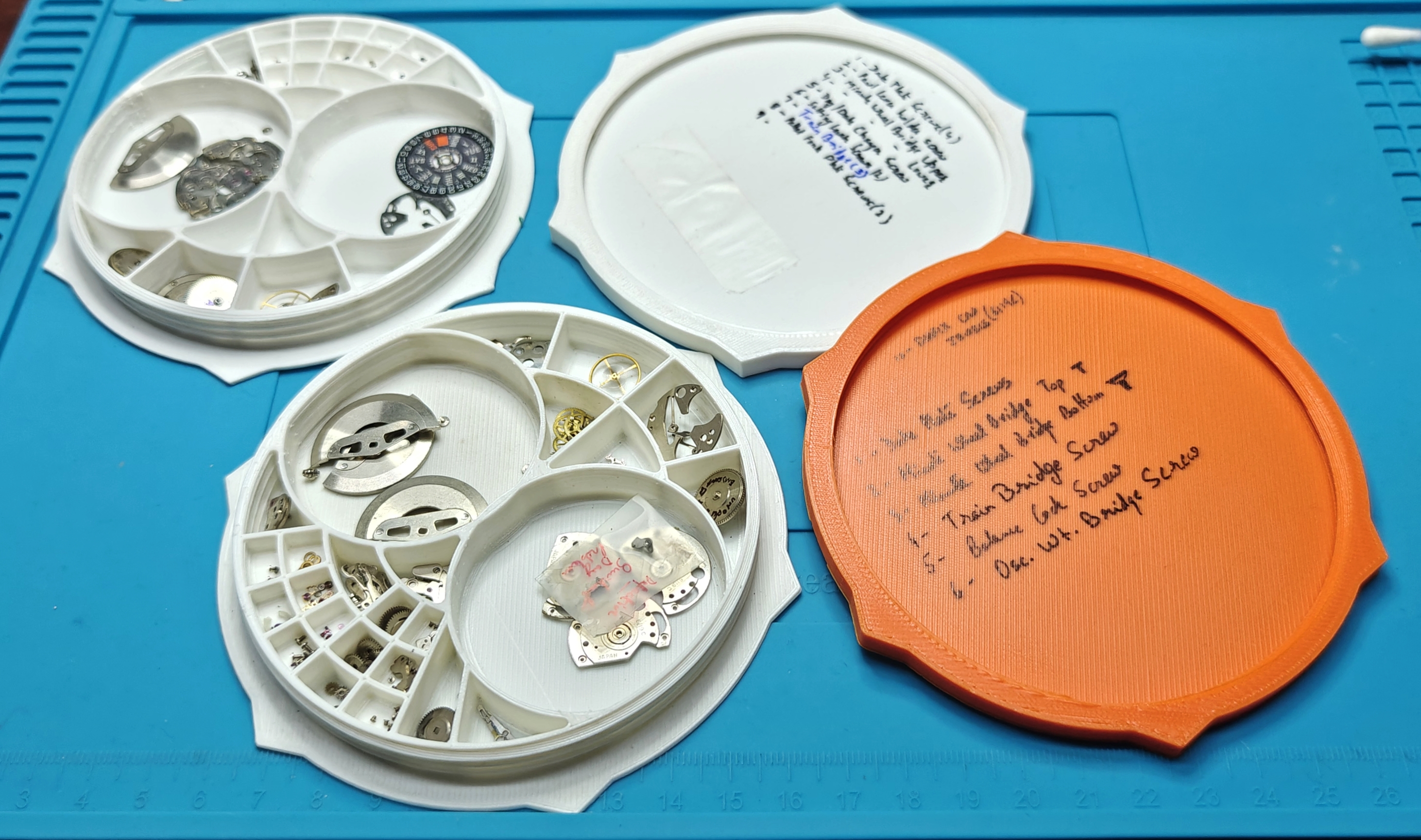
These are compartmentalised trays with a screw-on lid. I printed a few variants of these and even redesigned one with a few re-shaped and some deeper compartments. Available at https://www.thingiverse.com/thing:5969770

These are movement specific holders with appropriate ports cut out. They work really well and are very stable. You can redesign them and even make them taller to suit your working height.
The designs are freely available online and quite a few of them are collected together here: https://www.thingiverse.com/appumaster/collections/29780125/things

This is a very interesting print. Once assembled with some basic hardware, you will need a few extra components typically found in hobbyist electronics stores. A piezo buzzer (a.k.a. pickup microphone for musical instruments) wired to a battery-powered mini audio amplifier and connected to a PC with some free-to-use software results in a remarkably decent timegrapher! Changing the positions is not as convenient as in the Weishi 1000 but it gets the job done beautifully and if you are comfortable handling electronics, you can get a nice waveform to study the ticks and the tocks!
The free software is available at https://tg.ciovil.li/ and is quite well written with even an option for calibrating the readings with the internal clock of your PC motherboard.

Here’s tray to hold the cheap three-cup oiler and prop up your oilers too. Bonus space for rodico and pithwood for cleaning the tips.
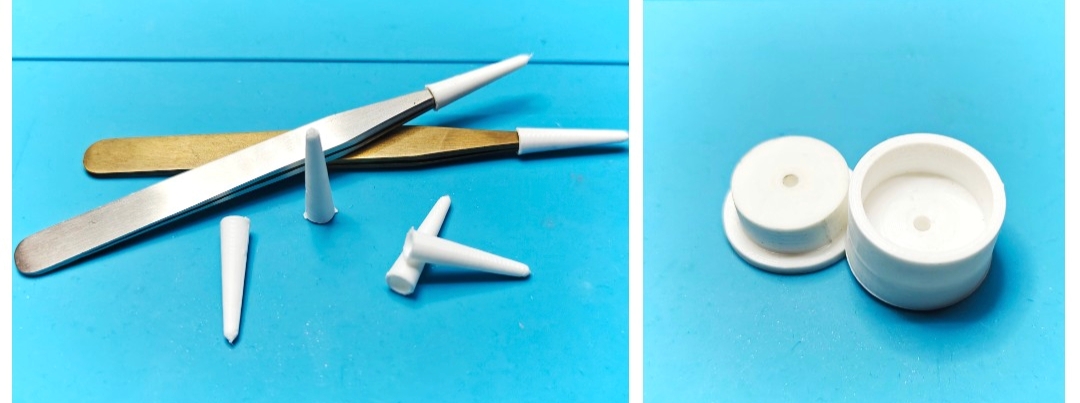
Some simple tweezers’ caps to protect the tips from damage (and your own self from accidental stab wounds- ask me how I know!)
Also, a simple contraption to apply even pressure for closing barrel lids. Most people get by with the two-tweezer-sandwich but there’s is a custom tool for it.

Some covered movement holders with a cutout for the stem and crown. Also, if your Seiko dial spacers or casing rings are missing or broken do not despair. Print one instantly!
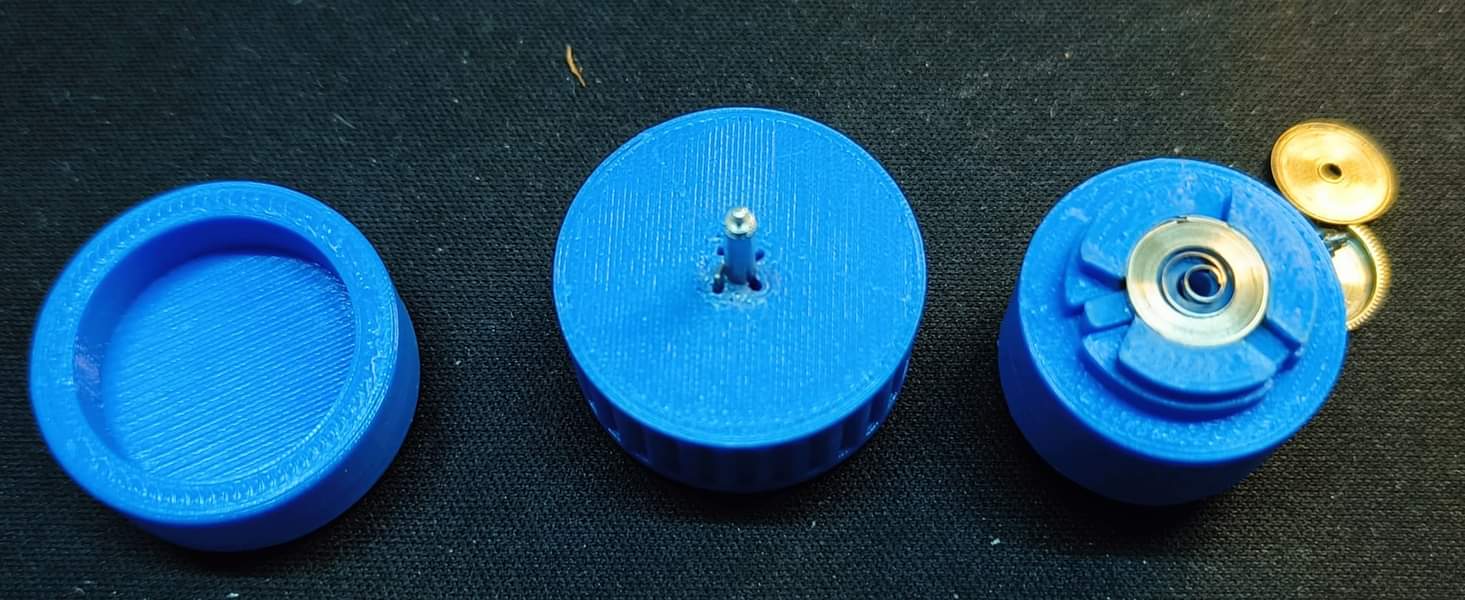
Mainspring Winders – a much needed tool when working on mechanical watches and one that adds up to a hefty sum if you were to get all the sizes as well as left-handed and right-handed winding versions. This is one of the cheapest alternatives I’ve seen so far that really works very well. It’s customisable and supports a wide range of mainspring sizes, both left and right-handed. The designer has put up very good explanations and videos so you should definitely check them out at https://github.com/vishnu350/rs-mainspring-winder
Is it fiddly? Yes…
Can the mainspring jump out suddenly and look like a ball of worms? Yes… but who has used a branded mainspring winder that doesn’t suffer from the same problems?
To sum up, you can find a lot of free prints online as well as some paid designs. Other examples are a stand/ guide to keep the hand presser tool vertical when installing hands and even a 3D printed watch cleaning machine! The best part is that with some extra effort one can learn how to design objects in CAD software and make them come to life quickly and cheaply.
I would love to hear from you readers about your favourite 3D-printed tools and equipment that have become integral to this fascinating hobby. Whether it’s a custom watch stand, a specialized movement holder, or any other innovative tool that has made your watch repair and restoration projects easier and more enjoyable, please share your experiences. Your insights and recommendations can inspire and assist others in our community who are exploring the endless possibilities of 3D printing in watchmaking.





 TheIndianSeikoSmith